


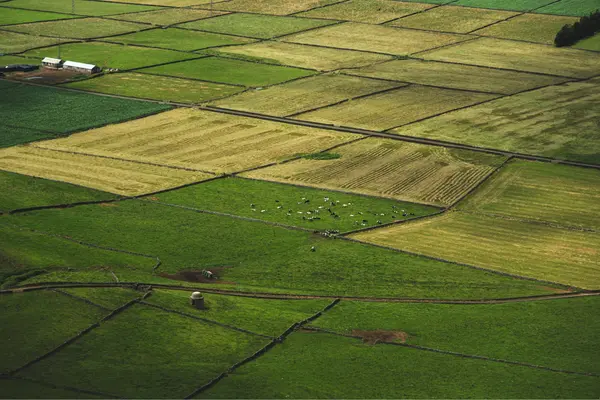
Comprehensive Criteria for Evaluating the Economic-Social Function
The analysis carried out by the authorities is not limited to observing the total surface area of the property. It involves a comprehensive evaluation of different factors that make it possible to determine which part of the property actually fulfills its purpose.
Effectively Used Areas
These are the areas where verifiable productive activity exists. On livestock properties, the National Agrarian Reform Institute verifies the number of cattle, the existence of cultivated pastures, silvopastoral systems, and the available infrastructure.
In agricultural activities, the authorities assess planted or harvested areas, as well as improvements that have been implemented, such as irrigation or storage systems.
Fallow Areas
These areas are recognized only on properties engaged in agricultural activity. They are surfaces that, for technical reasons, remain temporarily uncultivated in order to preserve soil fertility, provided that there is coherent production planning.
Growth Projection Areas
The analysis includes an additional margin that allows for the projection of the property’s productive expansion. This percentage may range from 30% to 50% over the effectively used and fallow areas, depending on the type of property.
Legal Ecological Easements
Areas intended for environmental conservation are recognized as part of compliance, as long as they are duly authorized and managed sustainably. On the other hand, activities such as illegal clearing not only do not contribute to compliance, but may also lead to sanctions.
Verification Hearing and On-Site Evidence Gathering
When there are signs of non-compliance, especially in reversion proceedings, a formal procedure is triggered and carried out directly on the property.
Beginning of the Procedure
The Departmental Director of INRA issues an administrative act setting the date and time for the verification hearing, which must be held on the land itself.
Development of the Hearing
The hearing is conducted continuously, in a single act. During this stage:
- The attendance of the summoned parties is verified.
- Evidence is submitted and produced on site.
- The physical measurement of productive areas is carried out.
- A preliminary determination is made regarding which surface area complies with the economic-social function.
In addition, a record is prepared containing all observations, signed by the parties and by the representatives of social oversight bodies.
Physical Verification and Consequences
The fieldwork makes it possible to determine precisely which areas may be subject to reversion. In cases where the owner prevents access, the authority may request assistance from the police to ensure compliance with the procedure.
Fraud Control and Forced Labor During Verification
Detection of Servitude Relationships
During the inspection, compliance with labor rights is verified. The existence of forced labor, servitude, or exploitative practices constitutes an absolute breach of the economic-social function, in line with the Political Constitution of the State and international treaties such as the International Labour Organization’s Forced Labour Convention.
Signs of Fraud
If attempts to simulate compliance are detected through false documentation or apparent activities, the authority initiates investigations ex officio. If fraud is confirmed, the challenged records are invalidated and only the real verification is taken into account in issuing the decision.
In summary, the size of a rural property does not by itself determine its legal validity. What matters is the effective fulfillment of its economic-social function. The comprehensive evaluation carried out by the authority considers both productive activity and compliance with environmental and labor standards, ensuring that the land plays an active role in sustainable development.
The law firm provides specialized agrarian law services, offering legal advice in verification proceedings, defense against reversion, and compliance with the economic-social function. Contact us for specialized guidance.
Frequently Asked Questions (FAQs)
Does the size of the property guarantee compliance with the economic-social function?
No. What matters is the productive and sustainable use of the land.
What areas are considered productive?
Those where there is verifiable agricultural, livestock, or forestry activity.
Do fallow areas count toward compliance?
Yes, but only on agricultural properties and under technical planning.
What happens if there is forced labor on the property?
It is considered total non-compliance and may lead to reversion.
Can fraud be investigated during verification?
Yes. The authority may act ex officio and invalidate false evidence.
The content of this article does not reflect the technical opinion of Rigoberto Paredes & Associates and should not be considered a substitute for legal advice. The information presented herein corresponds to the date of publication and may be outdated at the time of reading. Rigoberto Paredes & Associates assumes no responsibility for keeping the information in this article up to date, as legal regulations may change over time.